
Ashland, MA · Middlesex County
Draft & Smoke Problem Repair in Ashland, MA
We diagnose why your fireplace smokes, backdrafts, or refuses to draw — flue sizing, smoke chamber geometry, house pressure, wind effects — and fix the actual cause, not the symptom.
Draft diagnostics typically run $149–$299, and most corrective work — smoke chamber parging, damper replacement, or a draft-correcting cap — lands in a typical range of $350–$2,800 depending on what the evaluation finds; full reline projects are quoted separately.
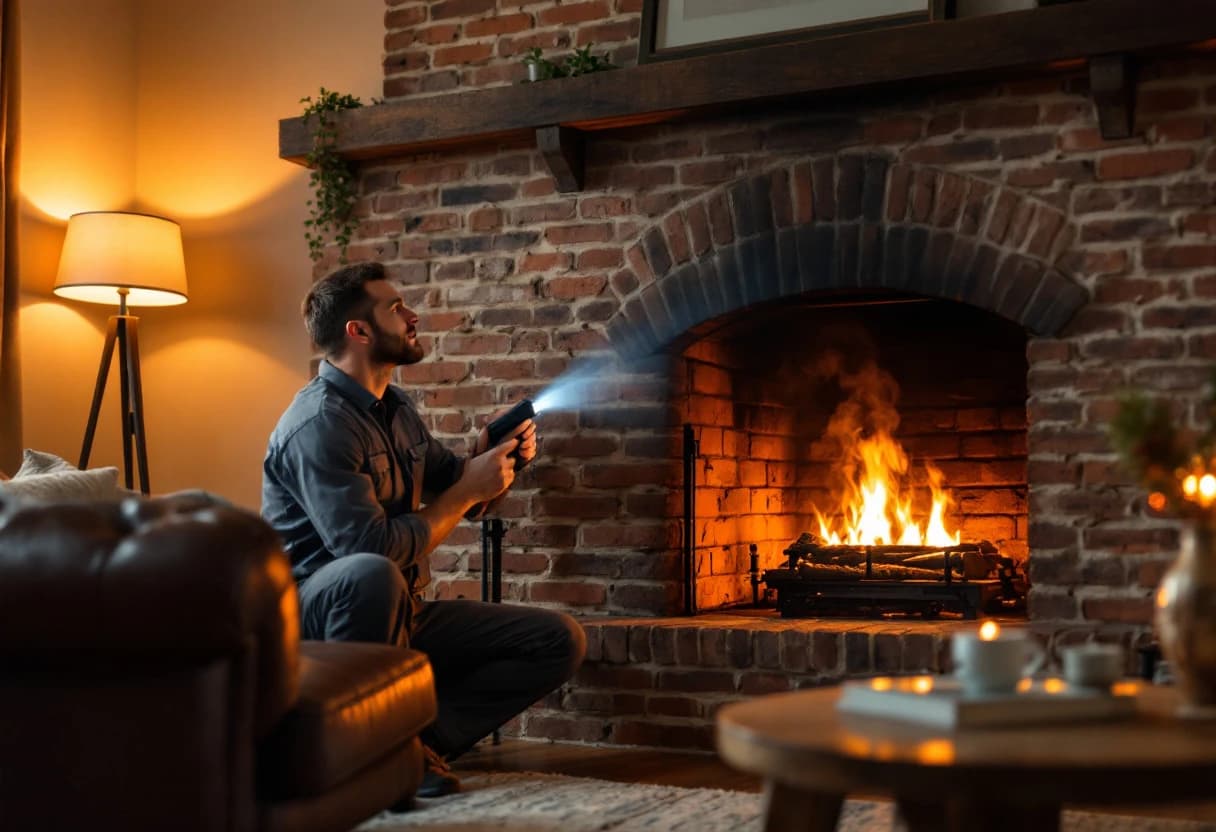
There is a particular pleasure to the first fire of the season, when the evenings in Ashland turn crisp and the woodpile finally earns its keep. That first fire is also when a summer's worth of hidden trouble announces itself: a bird's nest in the flue, a damper rusted half-shut, or creosote left over from last winter waiting for a spark. The difference between a cozy October evening and a call to the fire department often comes down to whether anyone looked up the chimney beforehand. Upside Down Chimney Sweeps exists to make sure someone does. We sweep, inspect, and repair chimneys throughout Middlesex County, and we would much rather find a problem in September than have you discover it in January.
A chimney is not a passive pipe; it is an engine that runs on temperature difference. Hot flue gases are lighter than the cold air outside, so they rise, and that rise pulls fresh combustion air through your fire. Engineers call it stack effect, and every smoky fireplace we see is a failure of that engine somewhere: the flue is the wrong size for the firebox, the smoke chamber is turbulent, the house is starving the fire of makeup air, or wind is shoving the column backwards. The frustrating part for homeowners is that all of these produce the same symptom, smoke in the room. Our job is to find which engine failure you actually have, because the fixes are completely different and guessing gets expensive.
Fireplace design follows ratios, and when the ratios are wrong no amount of kindling technique will save you. The classic rule of thumb is that a flue should have roughly one-tenth the cross-sectional area of the fireplace opening; NFPA 211 and masonry fireplace standards spell out the acceptable sizing relationships in detail. Too small a flue and the chimney simply cannot swallow the smoke a big firebox produces. Too large, and the gases rise slowly, cool against all that extra tile, and lose the buoyancy that drives the draft. We measure your actual opening, your actual flue, and your chimney height against the termination rules, the familiar three feet above the roof penetration and two feet above anything within ten, before we blame anything else.
New England housing adds its own complications. Across Ashland and the older towns around Boston, we constantly see flues that were sized for coal or oil equipment decades ago and never resized when the heating system changed, so a modern appliance breathes into a cavernous, cold flue that condenses and drafts poorly. On the other end of the spectrum, tightly air-sealed and renovated homes create negative pressure: the range hood, bath fans, and dryer all exhaust air, the house pulls replacement air down the path of least resistance, and that path is your chimney. Exterior chimneys on north-facing walls suffer cold hearth syndrome, where a column of dense cold air sits in the flue like a plug until you break it.
The good news is that draft problems are diagnosable and fixable, and the diagnosis is not guesswork when it is done with instruments and a camera instead of a wet finger in the wind. We follow NFPA 211 inspection practice and Chimney Safety Institute of America (CSIA) guidance, test the house and the flue as one system, and give you a written explanation of what is wrong in plain language before we propose anything. Some fixes cost a few hundred dollars; a few require relining. Either way you will know why, and you will stop dreading the first cold night of the season. Call (781) 653-5644 and tell us what your fireplace is doing; the story usually tells us half the answer.
What Our Draft & Smoke Repair Service Covers
1Draft Diagnosis & Pressure Testing
We reproduce the problem instead of theorizing about it. That means smoke-pencil testing at the firebox lintel, measuring flue temperature and draft, running the home's exhaust appliances to expose negative pressure, and scanning the full flue with a camera. We measure the fireplace opening against the flue area, check chimney height against the termination rules, and note offsets and restrictions. You get a written diagnosis that names the cause, or the combination of causes, since real-world smoke problems are frequently two small faults stacking on each other.
2Smoke Chamber Parging
The smoke chamber is the funnel between your firebox and the flue, and in most older masonry chimneys it was built from stepped, corbelled brick, a staircase of ledges that spins smoke into turbulence and snags creosote. We parge the chamber smooth with a refractory mortar rated for the job, converting those ledges into a seamless cone, which is what current NFPA 211 practice calls for. The difference is immediate: smoke accelerates through a smooth funnel instead of tumbling, and spillage at the lintel on startup often disappears entirely.
3Flue Resizing & Stainless Liner Installation
When the flue itself is the wrong size, we correct it with a UL-listed stainless steel liner sized to the appliance or fireplace it serves. An oversized flue, extremely common after oil-to-gas conversions in the older housing stock around Ashland, gets a properly sized insulated liner that keeps gases hot and buoyant all the way up. The insulation matters as much as the diameter: a warm flue starts drafting in seconds, resists condensation, and stops the acidic moisture that eats mortar joints from the inside.
4Damper Repair & Top-Sealing Dampers
A throat damper that will not open fully strangles draft; one that will not close leaks warm air all winter and lets a cold plug form in the flue. We repair or replace failed throat dampers, and where it suits the chimney we install top-sealing dampers that mount at the flue exit and seal with a silicone gasket. Closing the flue at the top keeps the whole column house-warm, which largely eliminates cold hearth syndrome on exterior chimneys and makes that first light dramatically easier.
5Wind & Termination Correction
Some chimneys draft beautifully until the wind blows. Roof geometry, taller additions, big trees, and neighboring buildings can all drive air down a flue, and coastal Massachusetts gets wind events that find every marginal termination. We correct chimneys that are too short for their roof penetration, and where turbulence is the culprit we fit draft-correcting caps designed to convert crosswind into updraft. During nor'easter season this is often the difference between a fireplace you use and one you avoid.
6Makeup Air & House Pressure Solutions
If the house is the problem, we treat the house. Modern air sealing, spray foam, and high-CFM range hoods can put a home under enough negative pressure that the chimney becomes the return duct. We demonstrate the effect live, so you can watch the draft reverse when the hood kicks on, then solve it with dedicated makeup air provisions, outside combustion air to the firebox where feasible, or operating guidance that actually works. A cracked window is a diagnostic clue, not a solution we consider acceptable.
Why Draft & Smoke Repair Matters for Ashland Homes
Smoke spillage is a health exposure, not just a nuisance. Wood smoke carries fine particulates and carbon monoxide, and a fireplace that spills at every light is dosing your living space with both, which is why the smell that lingers in curtains and upholstery should be treated as data. With gas and oil equipment venting into a poorly drafting flue the stakes climb further, because those flue gases are less visible and the backdrafting can be continuous rather than momentary. A fireplace or heating flue that will not draw is a combustion appliance running with its exhaust pipe partially disconnected, and it deserves the same urgency you would give that problem on any other appliance.
Poor draft also manufactures creosote at an accelerated rate. Slow, cool flue gases condense on the liner walls, and repeated condensation builds toward third-degree creosote, the glazed, tar-like stage that cannot be brushed off and burns with tremendous intensity if it ignites. This is the vicious cycle we interrupt: a lazy flue creates glaze, the glaze narrows the flue, the narrower flue drafts even worse. Oversized flues do the same damage with moisture, condensing acidic vapor that erodes mortar joints and spalls tile from the inside. Correcting the draft is therefore fire prevention and masonry preservation at the same time, not a comfort upgrade.
Finally, an unfixed draft problem quietly deletes your fireplace. Homeowners in Ashland tell us the same story every fall: the fireplace smoked at Thanksgiving two years ago, embarrassed them in front of guests, and has been cold ever since, in a region where a working hearth carries real value through a power outage in February. Meanwhile the open, unused flue leaks conditioned air all winter, effectively a window cracked open year-round. The repairs are almost always cheaper than living with either cost. Diagnosed properly, most smoky fireplaces in our service area are restored to daily use with one targeted correction rather than a rebuild.
Greater Boston weather asks masonry to survive genuine extremes. A chimney in Ashland may face humid ninety-degree afternoons in July and single-digit nights in January, along with the dozens of freeze-thaw crossings in between that make southern New England one of the tougher masonry climates anywhere. Materials expand and contract with every swing, mortar fatigues, sealants age, and metal components like caps, dampers, and flashing corrode faster in our damp air. None of this means chimneys here are doomed; it means maintenance schedules imported from gentler climates simply do not apply. An annual inspection is the standard everywhere under NFPA 211, but around here it earns its keep almost every single year, usually by catching weather damage early.
Signs You Need Draft & Smoke Repair in Ashland
- Smoke rolls out from under the lintel when you first light a fire, even though it clears up later.
- The fireplace drafts fine on calm days but pushes smoke into the room whenever the wind picks up.
- You smell cold, acrid chimney odor in the room on days you have no fire burning.
- Starting a fire requires holding burning newspaper up the flue to coax the draft into reversing.
- Smoke spills into the room when the range hood, bath fan, or clothes dryer is running.
- A noticeable column of cold air pours out of the firebox in winter, especially on exterior-wall chimneys.
- The fire burns lazily, smolders, or dies unless the glass doors or a window are cracked open.
- Soot staining is spreading across the upper lip of the fireplace opening or the mantel face.
- Your carbon monoxide detector has chirped or alarmed while the fireplace or heating appliance was running.
- The problem appeared after a renovation, new windows, spray-foam air sealing, or a new range hood.
How the Job Goes, Step by Step
1Listen First
The pattern of a smoke problem is diagnostic gold, so we start by asking exactly when it happens: only at startup, only in wind, only when the furnace or hood runs, only in certain seasons. Cold-start spillage points to flue temperature and geometry; wind-only smoke points to termination; appliance-linked smoke points to house pressure. Your answers focus the testing before we open a single tool bag.
2System Evaluation
We inspect the full venting system to NFPA 211 practice: firebox dimensions, damper throat, smoke chamber condition, flue size and height, cap and termination, and nearby rooflines and trees. A camera scan rules out the mundane blockages, nests, fallen tile, heavy creosote, that masquerade as design problems. We measure the opening-to-flue ratio directly, because an inch of extra firebox width can push a marginal system over the edge.
3Live Pressure & Draft Testing
With the house closed up as you actually live in it, we measure draft at the flue and then stress the system: range hood on, dryer running, bath fans up. Watching the draft numbers fall, or reverse, in real time tells us precisely how much of your problem is the chimney and how much is the house competing with it. We document the readings so the fix can be verified against a baseline afterward.
4Written Diagnosis & Options
You get the cause in plain English with photos and readings, plus the repair options ranked by effectiveness and cost. Sometimes there is a cheap fix and a thorough fix, and we will tell you honestly what each buys you. A smoke guard that shrinks the opening might solve a borderline ratio for a few hundred dollars; a properly sized insulated liner solves it permanently. You choose with real information.
5Corrective Work
We perform the repair, parging the smoke chamber, installing the UL-listed liner, replacing the damper, extending the flue, fitting the draft-correcting cap, or adding makeup air provisions, using materials rated for flue service and workmanship that follows the standards we diagnosed against. Most corrections are completed in a single visit; relines and chamber work can take two. We protect your floors and leave the hearth cleaner than we found it.
6Verification Burn
The job is not done until the fire proves it. We run a verification burn or draft test under the same conditions that used to cause smoking, hood on, doors closed, and compare the numbers to the baseline we recorded during diagnosis. You see the difference yourself before we leave, and you get the before-and-after documentation for your records and for resale disclosure down the road.
Local Knowledge: Draft & Smoke Repair in Ashland
Ashland pairs a 19th-century mill-town core of older colonials and Victorians near downtown with waves of newer construction, including large 1980s-2000s subdivisions and recent townhouse developments near the commuter rail. The older homes carry aging brick chimneys that often need repointing or relining, while the newer stock skews toward gas fireplaces and prefab flues.
Ashland was the original starting line of the Boston Marathon, and its downtown still has the compact, older housing of a railroad town. Homes around the reservoir and state park sit among heavy tree cover, where falling limbs and nesting animals make chimney caps one of the most requested fixes in town.
We regularly handle draft & smoke repair calls in Ashland and the surrounding towns of Framingham, Holliston, Hopkinton, Sherborn — so scheduling is fast and our pricing reflects local conditions, not guesswork.
A spring inspection is one of the smartest appointments on the chimney calendar. Burning season is finished, so the technician sees the flue at its dirtiest, and your sweep clears a full winter's creosote before it spends a humid summer hardening and generating the sour, smoky odor chimneys can develop in warm weather. Winter's freeze-thaw damage is fresh and visible, from crown cracks to failed mortar joints, and identifying it in April means repairs can be scheduled calmly rather than crammed into fall. Masonry work itself also wants warm weather, since mortar cures properly only above certain temperatures. Spring diagnosis, summer repair, fall enjoyment: that sequence is the whole strategy, and it starts with one appointment.
Why Choose Upside Down Chimney Sweeps
Good chimney work starts with good communication, and we structure every job around it. Before we begin, you get a clear scope and a clear price. During the visit, our technician explains what they are finding and photographs anything noteworthy inside the flue or up on the roof, places you would never see otherwise. Afterward, you receive a report that plainly states the condition of your chimney and any recommendations, ranked by urgency. Call our office and a person who knows your job answers, not a call center reading a script. None of this is revolutionary; it is simply how service companies used to operate, and we think Greater Boston homeowners deserve contractors who still work that way.
Draft & Smoke Repair FAQs — Ashland, MA
Why does my fireplace smoke only when I first light it?
Why does the fireplace smoke only on windy days?
We renovated and air-sealed the house, and now the fireplace smokes. Why?
Is my flue simply too small for my fireplace?
What is smoke chamber parging and do I actually need it?
My old oil flue was converted to gas and now there are draft and moisture problems. Are they related?
What does it cost to fix a smoky fireplace?
Can a draft problem really be fixed permanently, or will I always fight this fireplace?
Book Draft & Smoke Repair in Ashland
You searched for {keyword}, and the search can end here. Upside Down Chimney Sweeps handles this work for Ashland homeowners regularly, following NFPA 211 standards, documenting everything with photographs, and explaining findings without jargon or pressure. Call (781) 653-5644 to talk through your situation with someone who does this every day; a few minutes on the phone is usually enough to scope the visit and set a time. We show up when promised, protect your home while we work, and stand behind the results. There are certainly bigger companies and flashier websites out there, but for careful chimney work done close to home, we like our chances of earning your call and then keeping your business.
Book Draft & Smoke Repair in Ashland
Our Melrose shop is 26 miles away — scheduling in Ashland is fast. Call (781) 653-5644.
Mon–Sat: 7:00 AM – 7:00 PM · Emergency service available