
Belmont, MA · Middlesex County
Chimney Inspections (Level 1 & Level 2) in Belmont, MA
NFPA 211 Level 1 and camera-scanned Level 2 chimney inspections for annual maintenance, home sales, appliance changes, and post-event evaluations.
In the Boston market a standalone Level 1 inspection typically runs $99–$199, while a full camera-scanned Level 2 inspection generally falls between $249 and $549 depending on the number of flues.
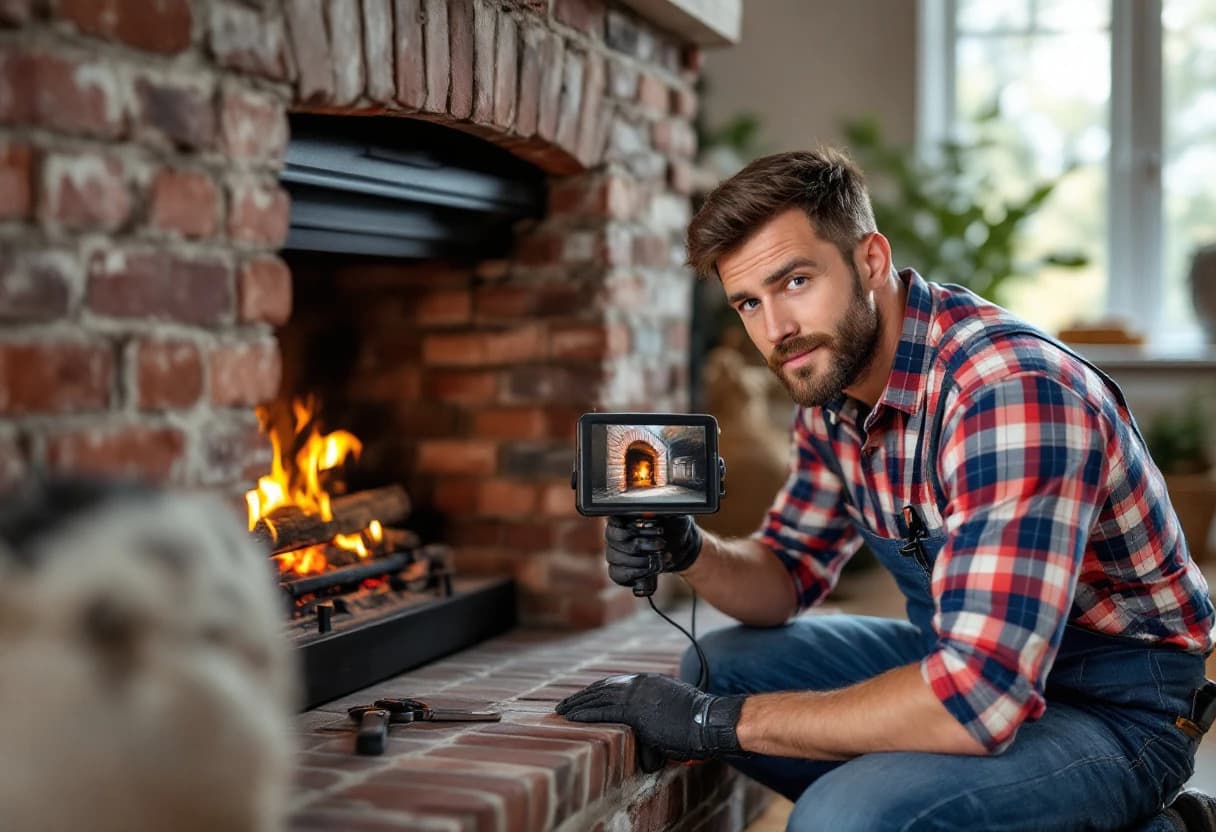
Upside Down Chimney Sweeps cares for fireplaces and flues across Middlesex County from our home base at 20 Sewall Street in Melrose, and Belmont sits squarely in the territory we know best. When our truck pulls into a Belmont driveway, the technician stepping out has seen hundreds of chimneys like yours: brick stacks on capes and colonials, terracotta-lined flues serving wood stoves, and masonry that has weathered more winters than most of us have. That familiarity matters. We do not guess at what a New England chimney needs; we inspect it, document what we find, and explain your options in plain English before any work begins. Whether you burn wood every night or light three fires a year, we are the neighbors to call.
Stand at your hearth and look up: past the damper, you can see perhaps three feet of a system that may run thirty. The other ninety percent of your chimney, the flue joints, the hidden bends, the clearances to framing inside your walls, the condition of the crown two stories overhead, is completely invisible from where you live. That blind spot is exactly what a chimney inspection exists to close. Cracked tiles, open mortar joints, shifted liners, and creosote glaze do not announce themselves; they sit quietly out of sight until a hot fire or a home sale finds them. An inspection is how you find them first, on your schedule and your terms.
NFPA 211, the national standard we follow, defines three inspection levels, and knowing which one you need saves both money and worry. A Level 1 is the annual checkup: a visual examination of all readily accessible portions of the chimney and venting system, appropriate when nothing about the system has changed and it has been performing normally. A Level 2 includes everything in a Level 1 plus accessible attics, basements, and crawl spaces, and critically, a video camera scan of the flue's full interior length. A Level 3, rarely needed, involves opening up concealed areas of the building when a serious hazard is suspected. Most homeowners will only ever need the first two.
A Level 2 is not an upsell; it is what the standard actually requires in specific situations. Per NFPA 211, a Level 2 inspection is called for upon sale or transfer of a property, after any operating malfunction or external event likely to have caused damage, such as a chimney fire, a lightning strike, or a building fire nearby, and whenever you change the way the system is used, including swapping fuel types, relining, or installing a new stove or insert. If you are buying a home in Belmont, this matters more than almost anywhere: the region's housing stock is old, and the general home inspection you paid for almost certainly disclaimed the chimney interior entirely.
Our inspections are built to give you evidence, not adjectives. The camera we run up your flue records every tile joint and every inch of liner, and the report you receive pairs those images with plain-English findings, priority rankings, and honest recommendations, including the recommendation to do nothing when nothing is wrong. Homeowners across Belmont and the surrounding towns use our reports to negotiate home purchases, satisfy insurance carriers, plan repairs, or simply sleep better in January. If your chimney has never had a documented inspection, or if you are staring down a purchase-and-sale deadline, call (781) 653-5644 and we will fit you in quickly.
What Our Chimney Inspection Service Covers
1Level 1 annual inspections
The Level 1 is the foundation of chimney safety and the version most homeowners need most years. We examine every readily accessible part of the system: firebox, damper, smoke chamber entrance, the visible flue, the exterior masonry from grade, and the crown, cap, and flashing when roof access is safe. We verify the flue is free of obstructions and combustible deposits and that the basic structure is sound. Performed annually, often alongside a sweep, it establishes a year-over-year record of your chimney's condition that makes any future change easy to spot.
2Level 2 video camera scans
The camera is what transforms an inspection from opinion into documentation. We run a high-resolution camera head the full length of each flue, examining every tile-to-tile joint, every offset, and every inch of liner under bright, even light. This is how you find the hairline crack three joints up, the missing mortar between tiles, the gap where a liner section shifted, or the glaze layer hiding above a bend. None of these are visible with a flashlight from the firebox, and every one of them matters to how safely your chimney contains heat and gases.
3Real estate transaction inspections
Buying or selling a home is the single most common reason for a Level 2, and the standard names property transfer explicitly. General home inspectors look at a chimney from the outside and note what they can see, then disclaim the rest, which leaves buyers inheriting flues sight unseen. We work within real estate timelines, scan every flue in the house, and deliver a photo-documented report your attorney, agent, or lender can actually use. Sellers order them too: a clean pre-listing inspection defuses the eleventh-hour chimney scare that derails so many closings.
4Post-fire and post-event evaluations
After any suspected chimney fire, lightning strike, or serious impact, the system needs a Level 2 before it is used again. Chimney fires leave signatures we know how to read: puffed or honeycombed creosote, cracked and spalled tile faces, warped dampers, and creosote flakes on the roof or ground. A nor'easter that drops a limb across your chimney or a strike that travels the stack can fracture tiles internally while the exterior looks fine. We document the damage thoroughly, which is exactly what your insurance carrier will ask for when a claim is filed.
5Appliance change and liner evaluations
Any change in how a chimney is used triggers a Level 2 under the standard, and for good reason: a flue that vented an oil boiler safely may be dangerously oversized for the high-efficiency gas unit replacing it, and a fireplace flue may be the wrong size or condition for the wood insert you want. We scan the flue, measure it, verify clearances, and tell you whether it can serve the new appliance as-is or needs a properly sized UL-listed stainless steel liner first. That answer, made before installation, prevents expensive rework after.
6Written reports with photos and priorities
Every inspection ends with a document, not a verbal shrug. Your report includes photographs and camera captures of anything notable, a description of each finding in plain language, and a priority level: safety items to address before the next fire, maintenance items to plan for, and observations that simply belong in the record. We separate what the standard requires from what is merely nice to have, and we put our name on the distinction. Customers use these reports for negotiations, insurance files, contractor bids, and year-over-year comparison at the next annual visit.
Why Chimney Inspection Matters for Belmont Homes
The danger in a compromised flue is quiet and cumulative. A chimney's one job is to keep fire and flue gases inside a sealed channel until they exit above your roof; a cracked tile or open joint breaks that seal and lets heat and carbon monoxide reach places they must never go. Wood framing often sits within inches of a chimney's exterior, and repeated heat exposure through a breach causes pyrolysis, a chemical change that lowers wood's ignition temperature season after season until a fire that the chimney once contained easily suddenly is not contained at all. No flashlight from the hearth can rule this out; a camera scan can.
For anyone buying property, the inspection is financial self-defense. Chimney repairs sit among the most expensive surprises in home ownership: a full reline can run several thousand dollars and a structural rebuild well beyond that, yet standard home inspections explicitly exclude flue interiors. In a hot market, buyers waiving contingencies inherit whatever the flue is hiding. The old coal-then-oil-then-gas heating history typical of homes around Belmont means many flues have spent decades bathed in acidic condensate that dissolves clay and mortar from the inside. A few hundred dollars of Level 2 scanning before closing routinely saves buyers many times that at the negotiating table.
Even absent a sale or scare, annual inspection is what keeps small problems small. New England weather attacks chimneys from above: freeze-thaw cycles pry open crown cracks, wind-driven rain from nor'easters saturates exposed brick, and salt air accelerates spalling near the coast. Each of these starts as a cosmetic finding and compounds yearly if unseen. An annual look, per NFPA 211 and the CSIA guidance we follow, catches the crown crack at the caulk-and-seal stage rather than the rebuild stage, and builds the documented service history that insurers increasingly want to see when a chimney-related claim ever crosses their desk.
Two humble components do most of the work of defending a chimney from New England weather: the cap and the crown. The cap is the metal roof over the flue opening, keeping rain, snow, animals, and debris out of the flue itself while its mesh screen arrests stray embers. The crown is the sloped masonry surface sealing the chimney top around the flue, shedding water away from the brick below. When either one fails, and around Belmont both eventually do, water enters the chimney's core, freeze-thaw damage accelerates, and blockages become more likely. The economics are lopsided in your favor: caps and crown repairs are among the least expensive chimney services, and they prevent some of the most expensive ones.
Signs You Need Chimney Inspection in Belmont
- You are buying or selling a home and the flues have never been camera-scanned.
- You are converting fuels, relining, or installing a new stove, insert, or heating appliance.
- You have had, or even suspect, a chimney fire, however brief.
- Lightning, a fallen limb, or storm damage has struck the chimney or roofline.
- You have no record of the chimney ever being professionally inspected.
- White staining, rust streaks, or dark patches are spreading on the chimney masonry.
- Pieces of flue tile or hardened mortar have appeared in the firebox or on the smoke shelf.
- Ceilings or walls near the chimney show damp spots or peeling paint after rain.
- The fireplace smell, draft, or burning behavior has noticeably changed this season.
- Your home predates 1940 and the flue may be unlined or lined with deteriorating clay tile.
How the Job Goes, Step by Step
1History and exterior walkaround
We begin by learning the system's story: what appliances vent into it, what has changed, and what prompted the call. Then we circle the exterior, reading the masonry from grade for step cracks, spalling, staining, and lean, and noting the crown, cap, and flashing condition from the ground or roof before any equipment is deployed.
2Interior accessible examination
Inside, we work through every readily accessible component: firebox joints, lintel, damper operation, smoke chamber entrance, ash pit, and cleanout doors. For Level 2 work we extend into attics, basements, and crawl spaces the chimney passes through, checking clearances to combustibles and looking for staining, efflorescence, or heat damage where the stack meets the structure.
3Rooftop examination
When conditions allow safe access, we inspect from above: crown surface, cap and spark screen, top flue tiles, the counter-stepped flashing where the chimney meets the roof, and the brick and joints in the weather zone that takes the worst of every nor'easter. This is where most water problems begin, and where they are cheapest to fix.
4Full-length camera scan
For Level 2 inspections, we run the video camera the entire length of each flue, recording as we go. We examine every tile joint, offset, and transition for cracks, gaps, spalling, and deposits, and capture still images of anything notable. You are welcome to watch the screen with us; most homeowners find their first look up their own flue genuinely eye-opening.
5Findings review on site
Before we leave, we sit down and show you exactly what we saw, image by image, in plain language. We explain which findings are safety-critical, which are maintenance planning items, and which are just for the record. You get straight answers to every question, and if the honest answer is that your chimney is in fine shape, that is the answer you get.
6Written report delivery
Your formal report follows promptly, with photographs, camera captures, findings, and prioritized recommendations laid out clearly enough to hand to an attorney, insurer, or contractor without translation. For real estate work we match the pace of your purchase-and-sale timeline, because we know an inspection report that arrives after the deadline may as well not exist.
Local Knowledge: Chimney Inspection in Belmont
Belmont's housing is dominated by handsome early-20th-century construction: brick Tudors and colonials on Belmont Hill, and closely set two-families and Victorians in the neighborhoods near Cushing Square and Waverley. Original masonry chimneys are nearly universal, many with ornamental brickwork that deserves careful repair. Multiple fireplaces per home are common in the larger houses on the hill.
Belmont Hill's elevation and mature architecture make for tall, prominent chimneys that are both exposed to weather and visible from the street, so owners here care about repairs that look right, not just work right. In the denser two-family neighborhoods below, shared flues and aging clay liners drive steady demand for inspections and relining.
We regularly handle chimney inspection calls in Belmont and the surrounding towns of Arlington, Cambridge, Watertown, Waltham — so scheduling is fast and our pricing reflects local conditions, not guesswork.
Winter is the season your chimney works hardest, and it deserves some attention even in mid-use. If you burn frequently, deposits accumulate faster than an annual schedule assumes, particularly when the wood is less than fully seasoned; heavy burners sometimes need a mid-season sweep. Winter is also when problems announce themselves: sluggish draft on cold starts, smoke odors migrating through the house, or a damper that suddenly stiffens. None of those should be ignored until spring. And if you ever suspect a chimney fire, however brief, stop using the fireplace and have the flue inspected before lighting the next one. We work straight through the winter for exactly these situations, and prompt attention keeps small issues small.
Why Choose Upside Down Chimney Sweeps
People ask about the name. Upside Down Chimney Sweeps comes from how we approach every job: from both ends. Plenty of problems hide from a technician working only at the hearth, and just as many hide from one working only on the roof. So we look up the flue from the firebox and down from the chimney top, check the crown and cap where weather attacks first, and examine the attic and rooflines where leaks leave their earliest evidence. Turning the routine upside down is a small discipline that catches the cracked tile, the failing flashing, and the nesting animals that a quicker visit would miss. It is a slightly odd name that stands for exactly the thoroughness you are hiring.
Chimney Inspection FAQs — Belmont, MA
What is the difference between a Level 1 and Level 2 inspection?
When is a Level 2 inspection actually required?
I already paid for a home inspection. Do I really need a chimney inspection too?
What does the camera actually show you?
How much does a chimney inspection cost in the Boston area?
How long does an inspection take, and can you meet a real estate deadline?
What happens if you find damage?
Is an inspection the same thing as a sweep?
Book Chimney Inspection in Belmont
What you are really buying from a chimney company is the ability to stop wondering. No more second-guessing the flue every time you light a fire, no more eyeing that stain on the ceiling near the chimney, no more resolving each October to deal with it next year. One call to Upside Down Chimney Sweeps at (781) 653-5644 settles the question for your Belmont home: a professional sweep, an inspection guided by NFPA 211, photographs of everything relevant, and recommendations ranked honestly by urgency. Most chimneys pass with minor notes, and their owners sleep better for knowing it. If yours needs work, you will know exactly what and why. Either way, the wondering ends.
Book Chimney Inspection in Belmont
Our Melrose shop is 9 miles away — scheduling in Belmont is fast. Call (781) 653-5644.
Mon–Sat: 7:00 AM – 7:00 PM · Emergency service available