
Canton, MA · Norfolk County
Emergency Chimney Service in Canton, MA
Rapid response for chimney fires, storm damage, carbon monoxide backups, blocked heating flues, and unstable masonry — we make it safe first, document everything, then plan the repair.
Emergency assessment and make-safe visits typically run $189–$450 in the Boston area, with temporary stabilization or weatherproofing commonly adding $300–$1,500 depending on access and conditions; permanent repairs are always quoted separately after the flue and structure are evaluated.
There is a particular pleasure to the first fire of the season, when the evenings in Canton turn crisp and the woodpile finally earns its keep. That first fire is also when a summer's worth of hidden trouble announces itself: a bird's nest in the flue, a damper rusted half-shut, or creosote left over from last winter waiting for a spark. The difference between a cozy October evening and a call to the fire department often comes down to whether anyone looked up the chimney beforehand. Upside Down Chimney Sweeps exists to make sure someone does. We sweep, inspect, and repair chimneys throughout Norfolk County, and we would much rather find a problem in September than have you discover it in January.
Some chimney problems can wait for a convenient Saturday. A chimney fire cannot. A stack of bricks scattered across your roof after a nor'easter cannot. A boiler flue packed with ice or debris in the middle of a January cold snap, in a house full of sleeping people, absolutely cannot. Upside Down Chimney Sweeps runs a dedicated emergency response out of Melrose for exactly these situations, serving Canton and communities across Greater Boston and Eastern Massachusetts. When you call (781) 653-5644 with an active emergency, we triage on the phone immediately, tell you what to do in the next ten minutes, and get a technician moving. The first visit has one goal: make your home safe. Everything else follows from there.
Chimney fires are the emergency people underestimate most, largely because many of them go unnoticed while they happen. A dramatic event announces itself with a roar like a freight train, flames or sparks at the cap, and dense smoke, but slow-burning flue fires can smolder against the liner with little more than an odd popping sound and a hot chimney breast. Either kind does damage: a flue fire can reach temperatures that crack clay tiles in a matter of minutes, and every crack is a pathway for the next fire to reach framing. That is why NFPA 211 calls for a Level 2 inspection after any operating malfunction or event likely to have caused damage, and why we treat every suspected flue fire as unproven safe until a camera says otherwise.
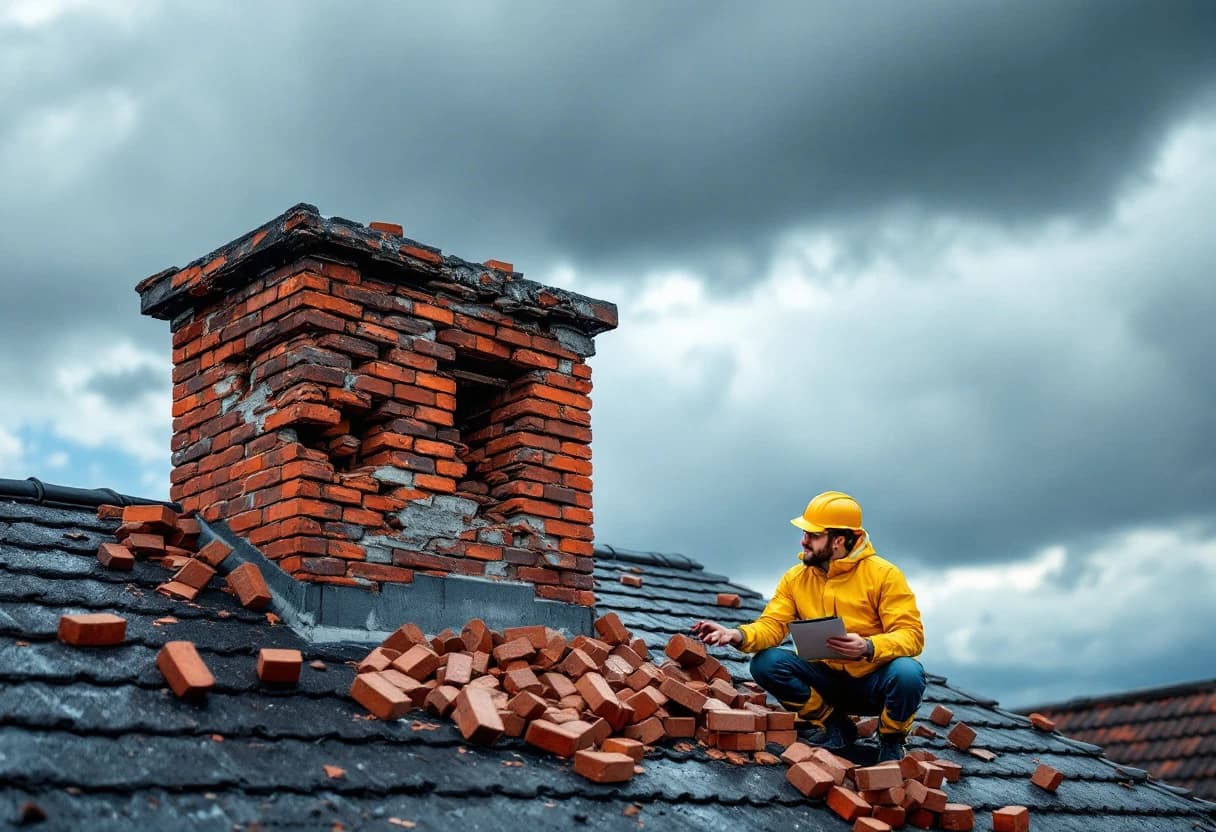
Then there is the weather, which in Eastern Massachusetts is an emergency generator all by itself. Nor'easters load chimneys with horizontal wind and wet snow; repeated freeze-thaw cycles pry apart mortar joints all winter until a saturated, weakened stack finally lets go in a storm; coastal salt air quietly accelerates the corrosion of caps, flashing, and reinforcement. After a major blow we see the same pattern across Canton: bricks in the yard, a crown split wide, a cap gone entirely, and rain pouring down an open flue into the smoke chamber. Storm damage rarely improves with time, because every day an opened chimney stands exposed, water is working on the masonry that remains.
Carbon monoxide events and blocked heating flues round out the calls we drop everything for. So much of the region's housing stock vents oil or gas heat through masonry chimneys that a single blockage, a collapsed liner, a frost-clogged termination, a bird that got into an uncapped flue, can push combustion gases into living space with no visible warning at all. If a CO alarm is sounding, leave the house and call 911 and your utility first; that is non-negotiable. Our role comes next: finding why it happened and restoring a safe venting path, following NFPA 211 and Chimney Safety Institute of America (CSIA) guidance, so your heat can come back on without a question mark hanging over it.
What Our Emergency Service Service Covers
1Post-Chimney-Fire Assessment
After a known or suspected flue fire, we perform a Level 2 inspection per NFPA 211: a full video scan of the flue interior plus examination of accessible attic, roofline, and cleanout areas. We look for the fire's fingerprints, cracked or spalled tiles, missing mortar joints, expanded and distorted creosote with a honeycombed, puffy look, and scorching at combustible clearances. You get a documented verdict on whether the system is safe to use, and if it is not, exactly what failed, with images your insurance carrier can work from.
2Storm & Wind Damage Response
When a nor'easter takes the top off a chimney, speed matters more than polish. We remove loose bricks and unstable sections before they come through a roof or onto a walkway, sheet and seal the opened flue against rain, and secure or replace a torn-off cap. Then we assess what the storm actually broke versus what decades of freeze-thaw had already weakened, because the two determine whether you are looking at a crown repair, partial rebuild, or full rebuild, and we document both for your claim.
3Carbon Monoxide & Blockage Emergencies
Once first responders have cleared the house, we find the cause. A camera scan locates the blockage or failure, ice and frost closure at the termination, a collapsed tile choking the flue, nesting debris, an offset packed with soot from an oil appliance, or a disconnected appliance connector. We clear what can be cleared, verify draft with instruments rather than assumption, and confirm the appliance can vent safely before you relight it. If the flue itself has failed, we tell you plainly and quote the reline.
4Emergency Leak Control
Active water pouring in around a chimney during a storm does damage by the hour, staining ceilings, saturating insulation, and feeding rot in the framing that carries your roof. We stop the water first with emergency-grade membrane, sealed sheeting, and temporary flashing over the failure point, whether that is a split crown, an open flue, or flashing peeled back by wind. With the home dry, we trace the true entry path, since chimney water routinely travels along framing and shows up rooms away from where it enters.
5Structural Stabilization
A leaning or visibly shifting chimney is a collapse hazard measured in tons, and it needs engineering judgment, not optimism. We evaluate how far the stack is out of plumb, what the mortar condition is below the visible damage, and whether the flue is still intact inside. Where the structure can be saved we brace and band it temporarily and schedule the rebuild; where it cannot, we take it down in controlled fashion to a sound course. Either way, nothing heavy stays poised over your family's heads while decisions get made.
6Emergency Flue Restoration
When a heating flue fails in winter, the repair is a race against the thermometer, because a Canton house without its boiler in February has a matter of hours before pipes are at risk. Where the situation allows, we restore safe venting fast with a UL-listed stainless steel liner sized to the appliance, insulated for condensation control, and connected and tested the same visit. When a same-day permanent fix is not possible, we set up a safe interim plan with your heating contractor rather than leaving you to improvise.
Why Emergency Service Matters for Canton Homes
The most dangerous chimney fire is the second one. A first flue fire often cracks tiles and blows out mortar joints without ever showing a flame in the living room, and the homeowner, not knowing it happened, keeps burning. The next hot fire sends flame and superheated gases through those fresh cracks into the chase, where framing that has been slowly dried out, a process called pyrolysis that lowers wood's ignition temperature season after season, is waiting. This is the mechanism behind house fires that start in the walls hours after the hearth fire burned down, and it is why a post-event inspection is not bureaucratic caution. It is the step that finds the crack before the fire does.
Carbon monoxide gives you even less to work with. It is colorless and odorless, the early symptoms, headache, nausea, fatigue, imitate coming down with something, and exposure at night compounds because everyone is asleep. A chimney does not need to look damaged to poison a house; a partial blockage or a quietly failed liner joint is enough when a boiler runs all night against it. This is the risk that makes us treat any venting question on heating equipment as an emergency rather than an appointment, and it is why the fix is never complete until measured draft and a clear camera scan prove the exhaust is going where it should, all the way to the top.
Waiting also costs real money in a climate like ours. An opened chimney, a missing cap, a split crown, exposed brick cores, takes on water with every storm, and every freeze afterward wedges those saturated pores apart from the inside; a repair that started as a crown and cap becomes a rebuild over one bad winter. Insurers, meanwhile, distinguish sudden storm damage from long-term neglect, so prompt professional documentation of what the event broke protects your claim as well as your masonry. The pattern we see across Greater Boston is consistent: the emergencies handled within days are footnotes, and the ones deferred to spring are projects.
Spring is when winter sends Canton homeowners the bill. As temperatures stabilize, the damage done by months of freeze-thaw cycling becomes visible: hairline crown cracks that widened, mortar joints that crumble at a touch, brick faces flaked off onto the roof, and white mineral staining called efflorescence, which is a chimney's way of announcing that water is moving through its masonry and leaving dissolved salts behind on the surface. None of these symptoms improves on its own, and all of them worsen faster once water has an established path. A spring inspection catches the winter's damage at its cheapest stage, and leaves the whole summer, the best season for masonry work, to repair it properly.
Signs You Need Emergency Service in Canton
- You heard a low roar or freight-train sound from the chimney, with popping or rumbling, during or after a fire.
- Flames, sparks, or dense dark smoke were visible coming out of the top of the chimney.
- You found puffy, honeycomb-textured creosote flakes in the firebox, on the smoke shelf, or on the roof.
- The chimney breast, wall, or a surface near the chimney got unusually hot to the touch.
- A carbon monoxide detector has alarmed, or family members have unexplained headaches or nausea at home.
- A storm left bricks, chunks of crown, or the chimney cap itself on your roof or in the yard.
- The chimney is visibly leaning, has a new crack you can see from the ground, or has shifted at the roofline.
- Water is actively dripping into the fireplace or staining the ceiling around the chimney during rain.
- Your heating system is short-cycling, fumes smell stronger than usual, or soot is appearing at the appliance draft hood.
- Smoke or combustion odor is entering the house from a fireplace or appliance that vented normally before.
How the Job Goes, Step by Step
1Phone Triage
Call (781) 653-5644 and tell us what happened. We ask targeted questions, what you saw and heard, whether alarms sounded, whether heat is down, and give you immediate instructions: when to call 911, whether to close the damper or leave it alone, whether to shut down an appliance, where not to stand. Genuine life-safety events get routed to first responders first; everything else gets a technician dispatched and an honest arrival window.
2On-Site Make-Safe
The first hour on site is about removing hazard, not finishing anything. We pull unstable masonry off the roofline, seal an opened flue against weather, isolate a compromised appliance from a failed flue, and cordon anything that could fall. Emergency work happens in bad conditions almost by definition, so our trucks carry the sheeting, bracing, and temporary flashing to leave every scene weathertight and stable the same visit.
3Assessment & Documentation
With the immediate hazard controlled, we find out exactly what happened. That means a Level 2 inspection per NFPA 211 where the event warrants it: full flue video scan, accessible attic and roofline examination, and instrument-verified draft on any affected appliance. Everything is photographed and written up in plain language, both so you understand your own chimney and so an insurance adjuster has professional documentation of what the event caused.
4Temporary Protection
If permanent repair has to wait, for weather, engineering, materials, or an insurance decision, the chimney does not wait unprotected. We install real interim measures: membrane-sealed covers over open flues, temporary caps, braced banding on questionable stacks, and clear guidance on what you can and cannot safely operate in the meantime. Interim does not mean improvised, and it does not mean a tarp held down by bricks.
5Repair Plan & Estimate
You get a written scope with priorities separated honestly: what is a safety necessity, what is a durability repair, and what can be scheduled at leisure. Where insurance is involved we align the documentation with your claim, distinguishing storm-caused damage from pre-existing wear, which adjusters respect and which protects you. There is no pressure sales in a stressful week; the numbers are typical of the Boston market and stand in writing.
6Restore & Verify
We complete the permanent repair, masonry rebuilt to a sound course, crown recast, UL-listed liner installed and insulated, cap and flashing restored, and then prove the system before handing it back. Proof means a camera pass of the finished flue, measured draft on reconnected appliances, and a final photo set for your records. Your chimney returns to service verified, not assumed, which is the whole point of everything that came before.
Local Knowledge: Emergency Service in Canton
Canton's housing runs from older colonials and Victorians near Canton Center to large tracts of postwar capes, ranches, and split-levels, plus newer subdivisions toward the Blue Hills. Many mid-century homes here were built with a single brick fireplace and an unlined or clay-tile flue that is now decades past its prime. The town's newer construction leans on prefab fireplaces and furnace flues that still need routine inspection.
Homes on the slopes near the Blue Hills Reservation take more wind exposure than most of Norfolk County, which accelerates cap and crown wear. Canton also has a deep industrial past — the Revere copper works rolled sheathing here — and its older village housing reflects that era's masonry. Freeze-thaw cycling off Ponkapoag's wetlands is hard on unsealed brick.
We regularly handle emergency service calls in Canton and the surrounding towns of Stoughton, Sharon, Norwood, Milton — so scheduling is fast and our pricing reflects local conditions, not guesswork.
Every fall, the same thing happens across Greater Boston: the first genuinely cold weekend arrives, thousands of homeowners simultaneously remember their chimneys, and every reputable sweep's calendar fills for weeks. The homeowners who called in August or September get their pick of appointments; the ones who call in late October wait, sometimes well past the first fires of the season. There is no downside to beating that rush. A chimney swept in late summer stays clean until burning season, inspection findings leave time for repairs before the cold, and scheduling stays flexible. If a fire on the first cold night matters to you, the honest advice from anyone in this trade is simple: book early, and burn easy.
Why Choose Upside Down Chimney Sweeps
Chimney work in New England is its own discipline. The housing stock around Greater Boston includes homes from nearly every decade since the Revolution, which means our technicians routinely encounter unlined flues, coal-era chimneys converted to gas, shared stacks serving multiple fireplaces, and brick manufactured to standards long since retired. Add a climate that freezes and thaws dozens of times each winter, and you have conditions no sunbelt training manual ever anticipated. Upside Down Chimney Sweeps works exclusively in this environment, so the judgment calls that matter most here, like when old mortar can be repointed versus rebuilt, or how to reline a flue without disturbing historic masonry, are calls we make every single week.
Emergency Service FAQs — Canton, MA
What should I do during a chimney fire, right now?
How do I know if I already had a chimney fire without realizing it?
Is it safe to use the fireplace after a chimney fire if it looks okay?
Will homeowners insurance cover my chimney emergency?
A storm knocked bricks off my chimney. How urgent is this really?
My carbon monoxide alarm went off. What is the right order of operations?
How fast can you actually get to my house?
Can chimney repairs even be done in the middle of winter?
Book Emergency Service in Canton
A well-maintained chimney is one of those quiet protections a house provides its family, like a sound roof or a dry basement, invisible right up until the moment it matters. Giving your Canton home that protection takes remarkably little: an annual inspection, sweeping whenever the flue needs it, and small repairs made before winter can enlarge them. Upside Down Chimney Sweeps would be honored to be the company you trust with that work, and starting is as simple as calling (781) 653-5644. We will treat your home with care, your questions with patience, and your budget with respect. The fires will feel better once you know for certain what condition their chimney is really in.
Book Emergency Service in Canton
Our Melrose shop is 20 miles away — scheduling in Canton is fast. Call (781) 653-5644.
Mon–Sat: 7:00 AM – 7:00 PM · Emergency service available