
Lowell, MA · Middlesex County
Creosote Removal in Lowell, MA
Specialized removal of heavy stage-2 and glazed stage-3 creosote using rotary equipment and chemical treatment — the buildup an ordinary brush sweeping cannot touch.
Heavy stage-2 mechanical removal typically runs $250–$450 per flue in the Boston market, while chemically treating and removing glazed stage-3 creosote usually falls between $450 and $900 depending on flue size and severity.
There is a particular pleasure to the first fire of the season, when the evenings in Lowell turn crisp and the woodpile finally earns its keep. That first fire is also when a summer's worth of hidden trouble announces itself: a bird's nest in the flue, a damper rusted half-shut, or creosote left over from last winter waiting for a spark. The difference between a cozy October evening and a call to the fire department often comes down to whether anyone looked up the chimney beforehand. Upside Down Chimney Sweeps exists to make sure someone does. We sweep, inspect, and repair chimneys throughout Middlesex County, and we would much rather find a problem in September than have you discover it in January.
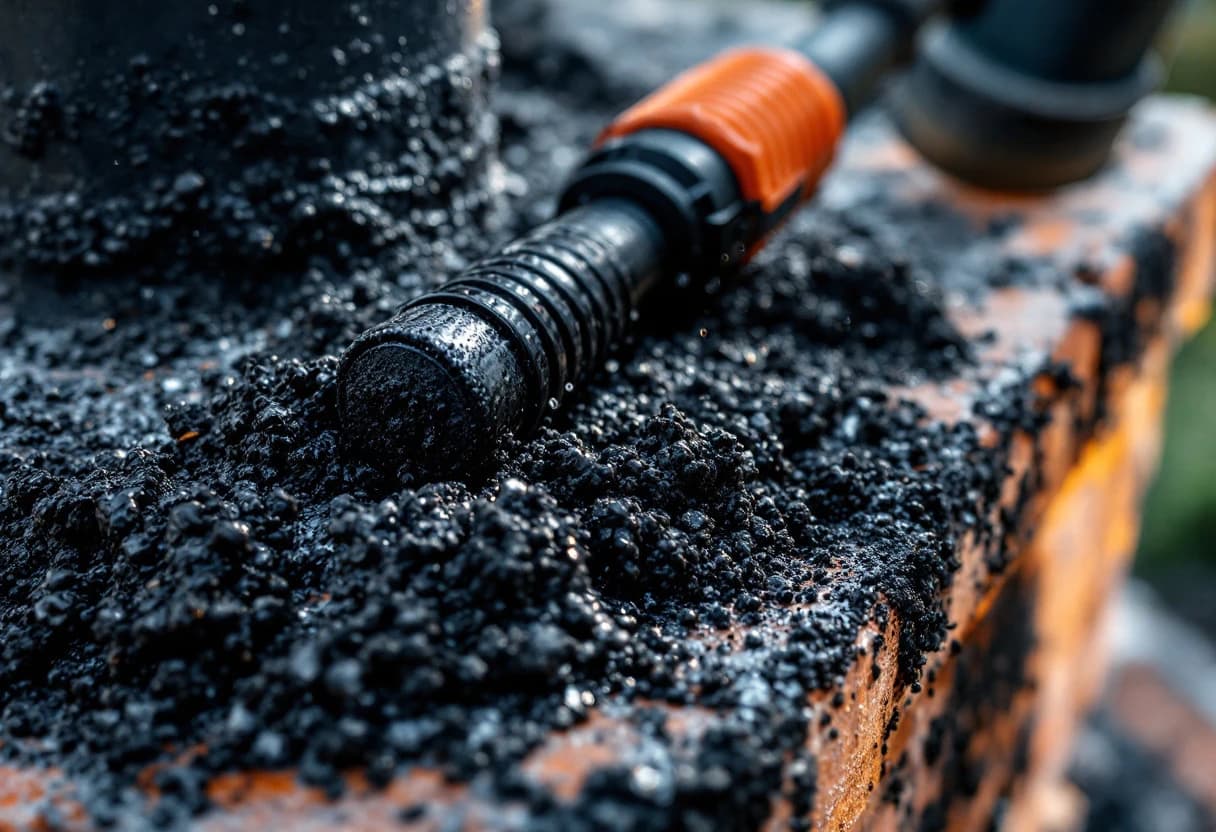
Creosote is not one substance; it is three, and the difference between them decides everything about how your chimney gets cleaned. Stage 1 is a soft, sooty powder that brushes out easily during a routine sweep. Stage 2 is harder: dry, crunchy flakes and shiny black chips, like burnt cornflakes fused to the flue wall, which demand stiffer tools and more aggressive passes. Stage 3 is the one that changes the conversation entirely. Also called glazed creosote, it is a dense, tar-like coating that has melted and re-hardened into something closer to enamel than soot. A brush skates across it. Removing it is a specialty service, and it is the service this page is about.
Understanding how glaze forms explains why it is so common in our region. Creosote condenses whenever smoke meets a flue surface below roughly 250 degrees, and everything about older Massachusetts housing conspires to keep flues cold: chimneys built on exterior walls with three sides exposed to January air, oversized flues left behind by coal-to-oil conversions that let smoke rise slowly and cool, and long masonry stacks on two-and-a-half story homes. Add the habits that starve fires of oxygen, burning unseasoned wood, damping a stove down to smolder overnight, and each fire lays down a fresh liquid layer that hardens over the last one, building glaze the way a candle builds drips.
Removing stage-3 creosote takes a fundamentally different toolkit. Mechanically, we use rotary rod systems driven by a drill and fitted with graduated heads, from flat-wire wheels up to controlled cable and chain assemblies, that chip hardened deposit off the flue wall without gouging clay tile or tearing stainless liner; head selection and technique matter enormously, which is why this is not a job for a rented brush. Chemically, we apply catalytic treatments to the glaze itself. These compounds soak in and change the creosote's structure, breaking it down into a brittle, ash-like layer that subsequent mechanical passes can actually grab. Severe glaze often takes staged visits: treat, burn or dwell per product directions, return, and remove.
What makes this service urgent rather than optional is simple arithmetic: stage-3 creosote is concentrated fuel bonded to the inside of a channel that runs through the middle of your house. It can ignite around 1,100 degrees, and once lit it burns ferociously, cracking tiles and finding every weakness in the stack. If a sweep has ever told you your flue was too glazed to clean fully, or you can see a shiny black coating above your damper, do not keep burning on top of it. We handle glaze removal for homeowners throughout Lowell and across Eastern Massachusetts; call (781) 653-5644 and we will assess it with a camera and give you a straight answer and a firm plan.
What Our Creosote Removal Service Covers
1Camera assessment and creosote staging
Before quoting anything, we need to know exactly what is on your flue walls, so we start with a video scan of the full flue length. The camera tells us the stage of the deposit, how thick it is, whether it is uniform or concentrated above offsets, and, critically, the condition of the liner underneath, since removal technique changes completely between sound clay tile, damaged tile, and stainless steel. You see the footage with us, we stage the creosote honestly, and you get a fixed plan and price before any removal begins.
2Mechanical rotary removal
For heavy stage-2 and softened stage-3 deposits, we run drill-driven rotary rods fitted with heads matched to the deposit and the liner: poly whips for finishing passes, flat-wire wheels for crusted flake, and controlled cable assemblies for hardened buildup on masonry flues. We work the flue in short, overlapping sections, stepping head aggressiveness up only as far as the deposit requires and the liner allows. The goal is bare, sound flue surface, not just a wider hole through the middle of the buildup, and we verify the difference on camera.
3Chemical treatment for glazed creosote
True glaze usually cannot be safely chipped off in one visit, so we treat it first. Catalytic creosote modifiers, applied as sprays, powders, or during controlled burns per the manufacturer's directions, penetrate the tar layer and chemically convert it from a dense, sticky solid into a dry, brittle, ash-like material. Once converted, deposits that once shrugged off a brush break away cleanly under normal rotary passes. Severe cases take more than one application over more than one visit, and we tell you that up front rather than promising a one-day miracle.
4Smoke chamber and smoke shelf deglazing
The smoke chamber is often the worst room in the house for creosote. Its corbelled brick steps and sudden expansion slow the smoke down right where it is coolest, and its rough surfaces give tar an ideal grip, yet it hides completely from view above your damper. We treat and hand-detail the chamber and the smoke shelf behind it with the same staging logic as the flue, because a glaze removal that stops at the first flue tile leaves the most ignition-prone deposit in the entire system exactly where a hot fire will find it.
5Post-chimney-fire creosote cleanup
A chimney fire changes creosote physically: deposits expand into puffy, honeycombed formations, rain down as large black flakes, and fuse to damaged tile faces. Clearing a flue after a fire is both a cleaning job and an evidence-handling job, since your insurer will want documentation of the event and the damage. We photograph conditions before touching anything, remove the burned deposits, and pair the cleanup with a Level 2 camera inspection per NFPA 211, so you know whether the liner survived before anyone lights another fire in that chimney.
6Prevention plan and burn coaching
Removal without prevention is a subscription, because glaze grows back under the same conditions that created it. Before we leave, we walk through why your specific flue glazed: fuel moisture, damper habits, flue size relative to the appliance, or an exterior chimney that runs cold. Then we give you a written prevention plan, which may be as simple as seasoned wood and hotter fires, or may point to a correctly sized UL-listed stainless liner that keeps flue temperatures up. Most repeat glaze problems we see are solvable once the root cause is named.
Why Creosote Removal Matters for Lowell Homes
Think of stage-3 creosote as roofing tar painted on the inside of a chimney: dense, energy-rich, and bonded to a surface designed to get hot. Even a modest accumulation represents an enormous fuel load, and when flue temperatures spike, from a big holiday fire, a load of dry scrap, or a wind-driven draft surge, it can ignite at around 1,100 degrees and burn past 2,000. At those temperatures clay tiles crack with a sound like gunshots, mortar joints open, and flame gets its first path toward framing lumber. Every serious chimney fire we are called to in Lowell starts with the same ingredient: heavy creosote nobody removed.
The more unsettling truth is that most chimney fires are quiet. The dramatic version, with a freight-train roar and flames torching from the cap, is the minority; far more often the glaze smolders and slow-burns unnoticed while the family watches television a few feet away, and the evidence, puffed honeycomb deposits, hairline-cracked tiles, a warped damper, surfaces only when a sweep or home inspector finally looks. Each unnoticed event leaves the flue weaker and adjacent framing more heat-degraded through pyrolysis, so the next fire meets less resistance. Removing heavy creosote is how you take that entire chain of events off the table.
Glaze does damage even if it never ignites. Creosote is acidic and hygroscopic: it pulls moisture from humid New England summer air and holds an acid-soaked compress against your liner for months, etching clay tile, corroding mortar joints, and pitting steel. It is also why glazed chimneys stink in July, that tarry, campfire-gone-wrong odor that intensifies with every muggy stretch and no air freshener touches. And because glaze thickens the walls of the flue, it narrows the passage, weakening draft and pushing smoke and carbon monoxide back toward the living space. Removal protects the masonry, the air, and the resale file all at once.
Spring is when winter sends Lowell homeowners the bill. As temperatures stabilize, the damage done by months of freeze-thaw cycling becomes visible: hairline crown cracks that widened, mortar joints that crumble at a touch, brick faces flaked off onto the roof, and white mineral staining called efflorescence, which is a chimney's way of announcing that water is moving through its masonry and leaving dissolved salts behind on the surface. None of these symptoms improves on its own, and all of them worsen faster once water has an established path. A spring inspection catches the winter's damage at its cheapest stage, and leaves the whole summer, the best season for masonry work, to repair it properly.
Signs You Need Creosote Removal in Lowell
- A flashlight aimed above your damper shows a shiny, wet-looking, or tar-like black coating.
- Drips, runs, or hardened black icicles of creosote are visible in the firebox or on the stove pipe.
- Puffy, popcorn-like, or honeycomb-textured deposits have appeared, a classic fingerprint of a past chimney fire.
- A strong tar or asphalt odor fills the room on humid summer days.
- Your fires burn sluggishly or need a cracked door or window to keep drafting.
- You regularly burn unseasoned wood or run your stove damped down overnight.
- Your chimney is on an exterior wall or serves an appliance far smaller than the flue.
- A previous sweep told you brushing alone could not remove what is in your flue.
- Large black flakes have appeared on the roof, in the yard, or on the smoke shelf.
- You are burning again after a suspected chimney fire without the flue having been cleared and inspected.
How the Job Goes, Step by Step
1Camera evaluation and staging
Every removal starts with a full-length video scan. We identify the creosote stage, map where the deposit is heaviest, and assess the liner beneath it, because technique and tooling depend on whether we are protecting sound clay, damaged tile, or stainless steel. You get a firm scope and price from the footage, not a guess from the hearth.
2Containment and protection
Glaze removal generates far more debris than a routine sweep, so containment is scaled up to match: sealed fireplace opening, drop cloths run wide, and HEPA-filtered vacuum capture running continuously. Chipped creosote is dense, sharp, and staining, and none of it belongs on your hearth rug. Interior protection stays in place until the final wipe-down.
3Mechanical removal passes
We work the flue with drill-driven rotary heads in graduated steps, starting conservative and increasing aggressiveness only as the deposit demands. Short, overlapping sections keep the cutting action controlled, and we check progress visually between passes. Stage-2 buildup usually surrenders here; hardened glaze that resists tells us the chemical phase is required.
4Catalytic treatment of remaining glaze
Surviving glaze gets treated with catalytic modifiers applied per manufacturer directions, sometimes in stages across more than one visit. The chemistry converts dense tar into a brittle, ash-like layer over days to weeks of normal use. We schedule the return visit before we leave, so the treatment cycle actually gets finished rather than forgotten.
5Final removal and camera verification
On the finishing visit we run final rotary passes to strip the converted deposit, detail the smoke chamber and shelf by hand, and then re-scan the flue on camera, comparing directly against the initial footage. You see the before and after yourself. If the scan exposed liner damage that the glaze had been hiding, we document it and explain your options plainly.
6Prevention plan and documentation
You receive a written report with the before-and-after imagery, the staging assessment, and a specific prevention plan: fuel and moisture guidance, burn-habit changes, and any structural recommendation such as a properly sized liner for a cold-running flue. The goal is that we never have to sell you this particular service twice for the same chimney.
Local Knowledge: Creosote Removal in Lowell
Lowell, the cradle of the American industrial revolution, is filled with 19th-century workers' housing: triple-deckers, rowhouses, and closely spaced two-families in neighborhoods like the Acre and Centralville, plus Victorians in Belvidere and postwar housing at the edges. Most chimneys are tall brick heating stacks serving multiple units, many original and unlined. Converted mill buildings add their own large-scale masonry questions.
Lowell's housing is dense and its chimneys are old, a combination that makes venting safety a real public-health issue rather than an abstraction. Oil-to-gas conversions, aging triple-decker stacks, and absentee-owner deferred maintenance are recurring themes in our Lowell work. City neighborhoods reward a sweep who can work in tight lots and coordinate with landlords and tenants alike.
We regularly handle creosote removal calls in Lowell and the surrounding towns of Chelmsford, Dracut, Tewksbury, Billerica — so scheduling is fast and our pricing reflects local conditions, not guesswork.
Every fall, the same thing happens across Greater Boston: the first genuinely cold weekend arrives, thousands of homeowners simultaneously remember their chimneys, and every reputable sweep's calendar fills for weeks. The homeowners who called in August or September get their pick of appointments; the ones who call in late October wait, sometimes well past the first fires of the season. There is no downside to beating that rush. A chimney swept in late summer stays clean until burning season, inspection findings leave time for repairs before the cold, and scheduling stays flexible. If a fire on the first cold night matters to you, the honest advice from anyone in this trade is simple: book early, and burn easy.
Why Choose Upside Down Chimney Sweeps
One thing homeowners appreciate about Upside Down Chimney Sweeps is that we handle the whole chimney, not just one slice of it. Sweeping, camera inspections, cap and damper replacement, crown repair, flashing, waterproofing, repointing, liner installation, and full rebuilds all live under one roof. That breadth matters because chimney problems rarely respect trade boundaries: a leak may involve the flashing, the crown, and the mortar joints all at once, and a company that only sells one fix tends to see only one cause. Because we diagnose and repair across the entire system, we can recommend the remedy the chimney needs rather than the one we happen to offer. Fewer handoffs also means one point of accountability from first call to final walkthrough.
Creosote Removal FAQs — Lowell, MA
What exactly are the three stages of creosote?
Why can't a normal chimney sweeping remove glazed creosote?
How much does creosote removal cost in the Boston area?
Is glazed creosote really that dangerous if it has been there for years?
How did my chimney develop stage-3 creosote in the first place?
Can I just burn creosote sweeping logs to get rid of glaze?
Could I have already had a chimney fire without knowing it?
How do I keep creosote from building back up after removal?
Book Creosote Removal in Lowell
From our shop on Sewall Street in Melrose, Lowell is a short and familiar drive, and that proximity is worth something practical to you: prompt scheduling, easy follow-ups, and a company whose reputation lives in the same corner of Massachusetts as your home. When you call (781) 653-5644, you reach people who know these towns, these winters, and these chimneys. We will set an appointment, arrive on time, protect your home while we work, and leave you with a written record of everything we found and everything we did. Local is not a slogan for us; it is the business model. We would be glad to add your chimney to the neighborhood we look after.
Book Creosote Removal in Lowell
Our Melrose shop is 24 miles away — scheduling in Lowell is fast. Call (781) 653-5644.
Mon–Sat: 7:00 AM – 7:00 PM · Emergency service available