
Northborough, MA · Worcester County
Chimney Waterproofing & Sealing in Northborough, MA
Brick and mortar drink water like a sponge — then New England winter freezes it. Our breathable siloxane treatments stop the absorption before spalling starts.
Most chimney waterproofing treatments in the Boston area run $300–$750 depending on chimney size and roof access, with crown coating or minor repointing adding a few hundred more when needed.
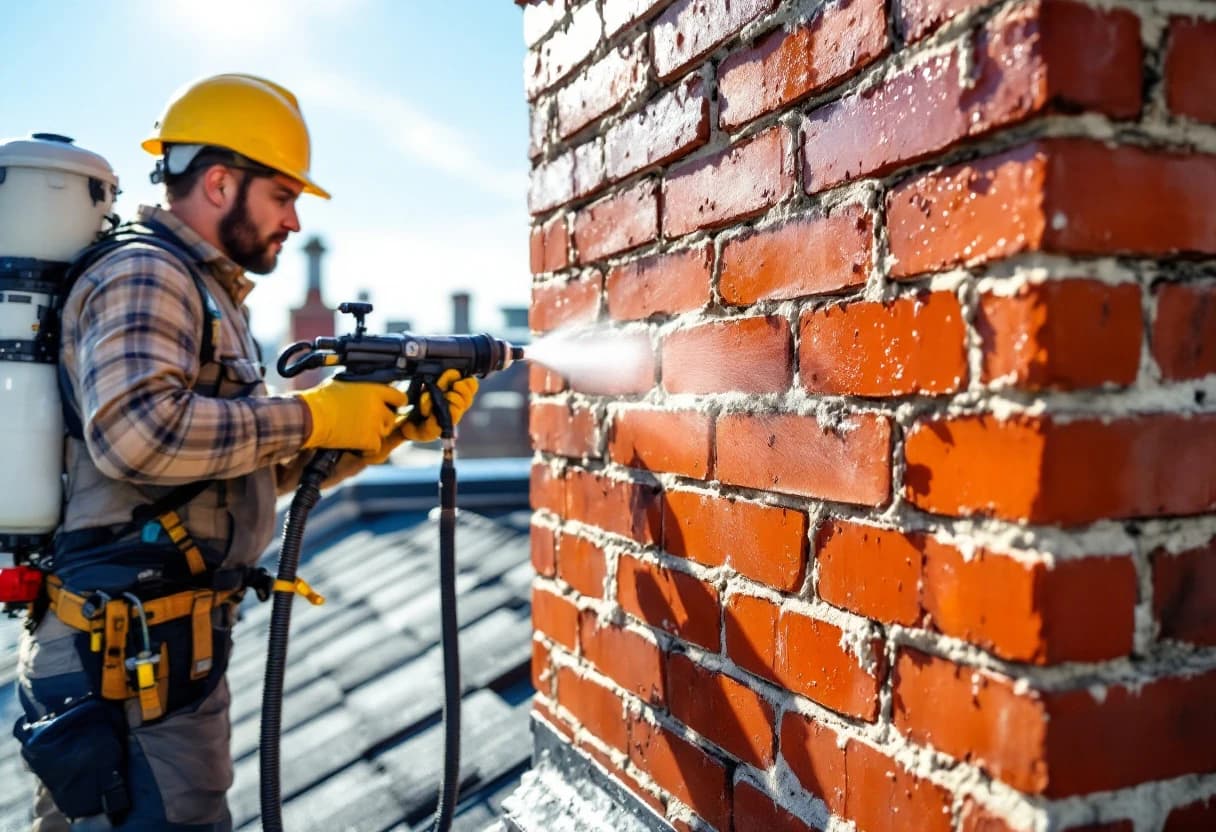
A chimney has the hardest job in the house and gets the least attention for it. It stands above the roofline through every storm that crosses Northborough, absorbs rain and snow into porous brick, and then gets blasted with heat from below all winter while acids in the flue gases work quietly on its mortar. No other part of your home endures fire on the inside and ice on the outside, sometimes in the same day. That is why chimneys fail slowly, quietly, and from several directions at once. Upside Down Chimney Sweeps was built around that reality. We inspect from the firebox up and from the crown down, so nothing in between goes unexamined and nothing gets the chance to surprise you.
Set a dry brick in an inch of water and come back in an hour: the waterline will have climbed the brick like a wick. Masonry is a sponge — brick, mortar, and block all pull water inward through capillary action, and the portion of your chimney above the roofline gets wetted on all four faces by every storm that crosses Massachusetts. In summer, most of that moisture evaporates back out. From November through April it does something worse: it freezes in place, expands roughly nine percent, and pries the masonry apart from within — flaking brick faces, powdering mortar, and opening ever-larger pathways for the next storm to exploit. Chimney waterproofing exists to interrupt that cycle at its first step, by stopping the absorption itself.
The word waterproofing suggests paint or a rubber coating, and that is exactly what it must not be. Masonry constantly needs to release vapor — moisture from combustion, from condensation inside the flue, and from the house itself migrates outward through the brick. A film-forming sealer traps that vapor behind an impermeable skin, where winter freezes it and shears the brick face right off; chimneys sealed with the wrong product often spall faster than untreated ones. What we apply instead is a penetrating siloxane- and silane-based water repellent: it soaks into the pore structure and chemically lines the pores so liquid water cannot wick in, while water vapor still passes out freely. The chimney sheds rain like waxed canvas but continues to breathe.
Waterproofing is the finishing move of good chimney maintenance, never a substitute for repair. A repellent cannot bridge a cracked crown, fill an open mortar joint, or re-seat failed flashing — water pouring through a defect simply bypasses the treatment. So we sequence the work properly: repoint failing joints, repair or coat the crown, confirm the cap and flashing are sound, and only then flood-coat the masonry field. Applied to a sound chimney, a quality repellent keeps the brick dramatically drier through the freeze-thaw season, slows spalling to a crawl, starves efflorescence and moss of the moisture they feed on, and typically protects for eight to ten years before re-treatment is due.
Chimneys around Northborough earn this protection more than most. Eastern Massachusetts stacks the deck against masonry: nor'easters that drive rain horizontally for hours, dozens of freeze-thaw cycles in a single winter, and — closer to the shore — salt air that keeps surfaces damp and accelerates decay. Much of the region's housing stock predates modern water-management details entirely, and older chimneys that once ran hot and dry over coal or wood fires now vent cooler, wetter appliance exhaust that adds moisture from the inside. Upside Down Chimney Sweeps applies breathable water repellents across Greater Boston from our shop in Melrose; call (781) 653-5644 and we will tell you honestly whether your chimney is a candidate or needs repair work first.
What Our Waterproofing Service Covers
1Pre-treatment condition assessment
We never spray a chimney we have not inspected. Before quoting waterproofing we examine the crown for cracks, the cap and flashing for function, the mortar joints for depth and hardness, and the brick faces for spalling — photographing all of it. If the masonry needs repair, we tell you and price it, because repellent applied over defects is money wasted. We also look for signs of internal moisture, like efflorescence patterns that suggest flue condensation, which waterproofing alone cannot solve. The assessment protects you from paying for the wrong fix.
2Vapor-permeable repellent application
We apply professional-grade siloxane and silane water repellents formulated for chimney masonry — never film-forming acrylic sealers. The material goes on as a flood coat, saturated from the bottom of the stack upward so the run-down soaks in evenly, followed by a second wet-on-wet pass that drives penetration deeper into the pore structure. Proper coverage rates matter more than brand names; a light misting fails early. Treated masonry beads and sheds rain while remaining fully breathable, and because the chemistry bonds inside the pores, it will not peel, blister, or discolor with UV exposure.
3Crown sealing and elastomeric coating
The crown — the sloped top surface that sheds water off the stack — takes more direct water than any brick below it, and hairline crown cracking is nearly universal on chimneys more than a decade old. As part of a waterproofing package we clean the crown, fill hairline cracks, and apply a flexible elastomeric crown coating that bridges movement through seasonal thermal cycling. Crowns that are structurally failed rather than surface-cracked get flagged for proper repair or rebuild instead — coating a collapsing crown just hides the problem for a season or two.
4Repointing and spall preparation
Repellent needs sound masonry to protect. Where we find scattered failing joints or a few spalled faces, we cut out and repoint the bad joints with compatible mortar and replace individual damaged bricks before treatment, giving new mortar time to cure before the flood coat goes on. Matching mortar hardness matters on the older homes around Northborough — a hard modern high-Portland mix against soft historic brick transfers stress into the brick itself. Small repairs folded into the same project keep the chimney watertight as a system rather than sealing defects permanently in place.
5Efflorescence and stain removal
Those white, chalky blooms on brick are efflorescence — mineral salts carried to the surface by migrating water and left behind as it evaporates. Beyond looking bad, they are a map of your chimney's moisture problem. We clean efflorescence, algae, and organic staining with appropriate masonry cleaners and low-pressure rinsing — never aggressive blasting, which opens the brick's pores further. A repellent applied over heavy salt deposits bonds poorly; cleaned first, it penetrates properly. And because treated brick stays drier afterward, the staining largely stops coming back.
6The full water-management check
Waterproofing only earns its keep as part of a complete water-management system, so every job includes a check of the other components: cap present and correctly sized, chase covers free of ponding, flashing engaged in its mortar joints, and the flue itself free of the condensation clues that point toward a liner problem. Where something is wrong we document it with photos and price the fix separately — no bundling games. The goal is simple: every path water can take into your chimney is either shed, sealed, or flagged, and you know exactly where things stand.
Why Waterproofing Matters for Northborough Homes
The arithmetic of waterproofing is lopsided. Treatment costs a few hundred dollars and lasts the better part of a decade; the failures it prevents — spalled brick faces, deep repointing, crown rebuilds, and in the worst cases partial chimney rebuilds — run from the low thousands into five figures. Freeze-thaw damage is also self-accelerating: every popped brick face and opened joint admits more water, so deterioration that took decades to begin can finish a chimney within a few hard winters around Northborough. Buying back that timeline for the price of a service call is the best value in chimney work, full stop.
Chimneys are unusual among masonry structures because they get wet from both directions. Rain attacks from outside while combustion vapor — especially from modern gas and oil appliances pushing cool, moist exhaust up old flues — condenses on the inside. This is why breathability is not a nice-to-have: a chimney sealed under an impermeable film has nowhere to release its internal moisture, and winter turns that trapped water into a wrecking bar working from within. Vapor-permeable repellents solve the outside problem without creating an inside one, and guidance from the Chimney Safety Institute of America (CSIA) likewise favors breathable repellents over paint-on sealers for exactly this reason.
No repellent rescues a chimney with a broken crown, failed flashing, or an uncapped flue — the biggest water entries are openings, not absorption. That is why we inspect before we treat and repair before we seal, and why we recommend keeping the annual inspection habit that NFPA 211 prescribes for every chimney, whether it is used regularly or not. An annual look catches the small stuff — a new hairline in the crown coat, a joint starting to soften — while it still costs almost nothing to fix, and confirms your waterproofing is still beading water years into its service life. Protection is a practice, not a product.
The single greatest enemy of masonry in Northborough is not fire; it is water paired with our freeze-thaw climate. Brick and mortar are porous, and every rain or melting snowfall lets moisture soak in. When temperatures drop below freezing, that trapped water expands roughly nine percent, prying the material apart from within. When it thaws, the water sinks deeper into the newly opened pores and waits to freeze again. Massachusetts winters can cycle above and below freezing dozens of times, and each cycle does its increment of damage. The visible result is spalling: brick faces popping off, mortar joints crumbling, and crowns cracking. Keeping water out of the masonry in the first place is why caps, crowns, and waterproofing earn their keep here.
Signs You Need Waterproofing in Northborough
- Brick that darkens in the rain and stays dark for hours after the storm has passed.
- White, chalky efflorescence blooming on the chimney's exterior faces.
- Small flakes or popped faces of brick appearing on the roof or on the ground below.
- Mortar joints that feel sandy or crumble when touched.
- Hairline cracks spidering across the chimney crown.
- Musty fireplace odors that come and go with humid weather.
- Interior staining near the chimney that appears seasonally rather than after specific storms.
- Moss, lichen, or algae colonizing the shaded faces of the masonry.
- Frost blooming on the exterior brick during winter cold snaps.
- A chimney that has never been treated, or was last waterproofed more than eight to ten years ago.
How the Job Goes, Step by Step
1Inspection and candidacy check
We start by confirming waterproofing is actually the right move. A technician inspects the crown, cap, flashing, joints, and brick faces, checks moisture behavior, and photographs the stack top to bottom. Chimneys with active defects get a repair plan first; chimneys already sound get scheduled for treatment. Either way you receive an honest written assessment — we would rather lose a waterproofing sale than seal a chimney that needed repointing.
2Repairs first, with curing time
Any needed repairs happen before treatment: repointing, spalled brick replacement, crown crack fill or elastomeric coating. Fresh mortar then needs time to cure before repellent is applied, so on chimneys needing masonry work we schedule the treatment as a short follow-up visit. Sequencing this correctly is the difference between a repellent that performs for a decade and one that locks moisture into green mortar.
3Cleaning and surface prep
The masonry is cleaned of efflorescence, soot streaking, moss, and organic growth using masonry-appropriate cleaners and gentle rinsing. The surface must be sound, clean, and dry for the repellent to penetrate — application over dirt or salt deposits is the most common cause of early failure. We also verify a dry-weather window, since the brick needs to be dry going in and rain-free for several hours afterward.
4Masking and protection
Before spraying, we protect everything the repellent should not touch: surrounding roofing is covered, adjacent siding shielded, and plantings below the work area draped. Overspray control is part of the craftsmanship — siloxane repellents are not something you want beading on your shingles or windows. Ladders and staging are set so the entire stack, including the tight faces near the roofline, gets even coverage rather than just the easy sides.
5Two-pass flood application
We apply the repellent as a saturating flood coat from the bottom of the masonry upward, so material running down is absorbed by brick that is already wetting out. A second pass follows wet-on-wet to push penetration deeper. Manufacturer coverage rates are followed, not stretched to save product. The crown coating, when part of the job, is completed in the same visit, and all treated surfaces are left to cure undisturbed.
6Verification and service record
Once cured, treated masonry visibly beads water, and we confirm performance with a light spray test. You receive photos, the name of the product applied, coverage details, and a recommended re-treatment window — typically eight to ten years depending on exposure. We log all of it, so future annual inspections can track how the treatment is holding and catch the right moment to renew it, long before the brick starts drinking again.
Local Knowledge: Waterproofing in Northborough
Northborough's housing stock leans on center-entrance colonials and garrisons built in subdivision waves from the 1960s through the 1990s, most with brick fireplaces and full masonry chimneys. Scattered along Route 20 and the older town roads are 18th- and 19th-century farmhouses with large original chimneys. Newer construction near Northborough Crossing trends toward gas fireplaces vented through prefab metal flues.
Northborough sits well inland in Worcester County, where winters run colder than along the coast and the heating season stretches longer. Wood stoves remain common on the town's larger wooded lots, so stove flues here see heavy seasonal use. That inland freeze-thaw cycling is especially hard on the mortar joints of the town's surviving farmhouse chimneys.
We regularly handle waterproofing calls in Northborough and the surrounding towns of Westborough, Marlborough, Hudson, Bolton — so scheduling is fast and our pricing reflects local conditions, not guesswork.
There is a quiet advantage in chimney care: the best time to schedule is precisely when nobody is thinking about chimneys. Spring and summer appointments book quickly and without the fall backlog. If an inspection uncovers something significant, like a failing liner or a deteriorated crown, you have months of good weather to plan and complete the repair instead of scrambling before the holidays. Timelines for masonry work are friendlier when crews are not overbooked. And a clean flue in May means no creosote smell all summer and one less item on the autumn to-do list. Calling a sweep in the off-season feels premature right up until October arrives and proves it was foresight.
Why Choose Upside Down Chimney Sweeps
People ask about the name. Upside Down Chimney Sweeps comes from how we approach every job: from both ends. Plenty of problems hide from a technician working only at the hearth, and just as many hide from one working only on the roof. So we look up the flue from the firebox and down from the chimney top, check the crown and cap where weather attacks first, and examine the attic and rooflines where leaks leave their earliest evidence. Turning the routine upside down is a small discipline that catches the cracked tile, the failing flashing, and the nesting animals that a quicker visit would miss. It is a slightly odd name that stands for exactly the thoroughness you are hiring.
Waterproofing FAQs — Northborough, MA
What is the difference between waterproofing and just painting or sealing the brick?
How long does chimney waterproofing last?
Can you waterproof a chimney in cold weather?
Will waterproofing change how my chimney looks?
My chimney already leaks — will waterproofing fix it?
Is it worth waterproofing a chimney I barely use, like a gas or oil flue?
What does chimney waterproofing cost?
What actually makes brick spall, and does waterproofing prevent it?
Book Waterproofing in Northborough
A well-maintained chimney is one of those quiet protections a house provides its family, like a sound roof or a dry basement, invisible right up until the moment it matters. Giving your Northborough home that protection takes remarkably little: an annual inspection, sweeping whenever the flue needs it, and small repairs made before winter can enlarge them. Upside Down Chimney Sweeps would be honored to be the company you trust with that work, and starting is as simple as calling (781) 653-5644. We will treat your home with care, your questions with patience, and your budget with respect. The fires will feel better once you know for certain what condition their chimney is really in.
Book Waterproofing in Northborough
Our Melrose shop is 35 miles away — scheduling in Northborough is fast. Call (781) 653-5644.
Mon–Sat: 7:00 AM – 7:00 PM · Emergency service available